
Introduction
India, one of the world’s oldest civilizations, boasts a history that spans over five millennia. The land known as Bharatvarsha has been a cradle of culture, spirituality, science, and philosophy. From the ancient Indus Valley Civilization to the rise of modern India, the subcontinent’s journey reflects a unique blend of continuity and change. Its history is not merely a record of kings and empires but a narrative of evolving societies, religions, and ideas that shaped the very identity of Indian civilization.
1. The Dawn of Civilization: Indus Valley (c. 2600–1900 BCE)
The story of India begins with the Indus Valley Civilization, one of the world’s earliest urban cultures, flourishing around the Indus River basin in present-day Pakistan and northwest India. Major cities like Harappa and Mohenjo-Daro were marvels of urban planning, featuring grid-pattern streets, advanced drainage systems, and standardized brick construction.
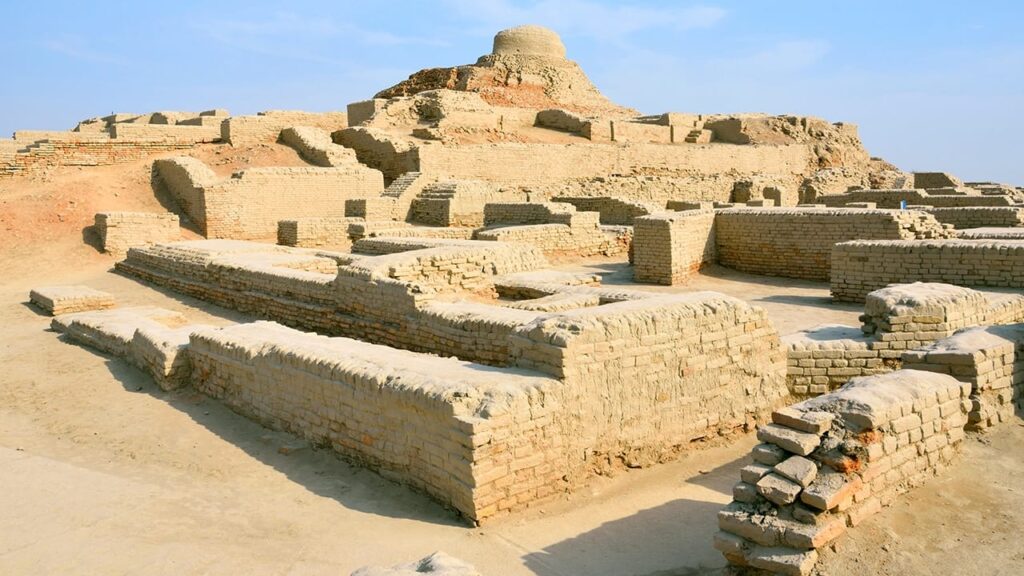
The people of this civilization engaged in trade with Mesopotamia, produced exquisite crafts, and had a writing system still undeciphered today. Though its decline around 1900 BCE remains debated, reasons may include environmental changes or the shifting of river courses. The legacy of Harappan urbanism and craftsmanship continued to influence later Indian cultures.
2. The Vedic Age (c. 1500–600 BCE)
Following the decline of the Indus Civilization, the Vedic Age marked the arrival of Indo-Aryan tribes who composed the Vedas, the foundational scriptures of Hinduism. Society during this era was largely pastoral, but it gradually transitioned to an agricultural one. The Rigveda, the oldest text, reflects a world of gods, rituals, and hymns celebrating natural forces.
Social organization took shape through the Varna system, laying the roots of later caste structures. By the Later Vedic Period, kingdoms and city-states began to emerge, and philosophies such as karma (action), dharma (duty), and moksha (liberation) became central to Indian thought.
3. The Age of Mahajanapadas and Religious Revolutions (c. 600–321 BCE)
By the 6th century BCE, sixteen powerful kingdoms known as Mahajanapadas dominated northern India. This era witnessed significant social and political changes, and, most notably, the emergence of new religions and philosophies.
Gautama Buddha, in the 6th century BCE, founded Buddhism, emphasizing the Middle Path and liberation from suffering. Mahavira, founder of Jainism, preached non-violence (ahimsa) and self-discipline. These movements challenged Vedic orthodoxy and emphasized moral and spiritual reform.
This period also witnessed advances in trade, urbanization, and political organization, paving the way for India’s first great empire.
4. The Mauryan Empire: India’s First Unifier (321–185 BCE)
Chandragupta Maurya, guided by the brilliant strategist Chanakya (Kautilya), established the Mauryan Empire — India’s first centralized and vast political entity. At its zenith under Emperor Ashoka, the empire stretched from Afghanistan to Bengal and south to Karnataka.
After the brutal Kalinga War, Ashoka embraced Buddhism, promoting peace, tolerance, and welfare through his famous edicts inscribed on pillars and rocks across the subcontinent. His reign marked a golden chapter in governance, diplomacy, and ethical statecraft.
The Mauryan decline after Ashoka led to regional fragmentation, but the ideals of unity and dharma continued to shape Indian political thought.. The Classical Age: Gupta Empire and the Golden Age (c. 320–550 CE)
Centuries later, the Gupta Empire rose to prominence, ushering in what historians call the Golden Age of India. Under rulers like Chandragupta I, Samudragupta, and Chandragupta II (Vikramaditya), India witnessed extraordinary achievements in art, science, literature, and mathematics.
Aryabhata introduced the concept of zero and advanced astronomy. Kalidasa, the great Sanskrit poet, composed masterpieces such as Abhijnanasakuntalam. Temples like those at Deogarh and Ajanta reflect refined craftsmanship and devotion.
Economically prosperous and culturally vibrant, Gupta India became a beacon of knowledge that influenced regions as far as Southeast Asia.
6. Early Medieval Period: Regional Kingdoms and Cultural Synthesis (c. 600–1200 CE)
After the fall of the Guptas, India entered an age of regional kingdoms. The Chalukyas, Pallavas, Rashtrakutas, and Cholas in the south built magnificent temples and promoted literature in regional languages.
The Chola Empire, especially under Rajaraja Chola I and Rajendra Chola I, expanded overseas influence into Sri Lanka and Southeast Asia, demonstrating India’s maritime prowess.
In the north, Rajput clans like the Chauhans and Paramaras dominated, known for their valor and patronage of art. The Bhakti movement began during this time, emphasizing personal devotion over ritualism — saints like Appar, Nayanars, and Alvars laid its foundation.
7. The Delhi Sultanate (1206–1526 CE): The Advent of Islam
The Delhi Sultanate marked a new phase in Indian history with the establishment of Islamic rule. Founded by Qutb-ud-din Aibak after the decline of the Ghurid Empire, it evolved through five dynasties — the Slave, Khilji, Tughlaq, Sayyid, and Lodi.
Sultans like Alauddin Khilji expanded the empire and introduced economic reforms, while Muhammad bin Tughlaq pursued ambitious but often impractical policies. The Sultanate facilitated cultural exchanges between Islamic and Indian traditions, visible in architecture such as the Qutub Minar and Alai Darwaza.
The synthesis of Persian art with Indian motifs laid the groundwork for the Indo-Islamic culture that would flourish under the Mughals.
8. The Mughal Empire (1526–1857 CE): Splendor and Consolidation
In 1526, Babur defeated Ibrahim Lodi at the Battle of Panipat, founding the Mughal Empire. His grandson Akbar the Great (1556–1605) expanded it into one of the world’s largest and most stable empires. Akbar’s policy of Sulh-i-Kul (universal tolerance) fostered religious harmony, while his administrative reforms built a strong central government.
Under Jahangir, Shah Jahan, and Aurangzeb, the empire reached new artistic and architectural heights — epitomized by the Taj Mahal, Red Fort, and Fatehpur Sikri. The Mughal period also saw Persian literature, miniature painting, and music flourish.
However, by the 18th century, internal weaknesses, regional revolts, and the rise of European colonial powers led to the empire’s decline.
9. The Colonial Era: The British Raj (1757–1947)
The 18th century marked a turning point as European traders, initially represented by the British East India Company, began asserting control over Indian territories. The Battle of Plassey (1757) gave the British dominance over Bengal, and by the 19th century, they ruled most of India either directly or through princely states.
The British introduced modern administration, railways, telegraphs, and education, but also drained India’s wealth and disrupted its traditional industries. The 1857 Revolt, led by soldiers, peasants, and princes, was India’s first major struggle against colonial rule. Though suppressed, it laid the foundation for future resistance.
By 1858, after the revolt’s failure, India came under the British Crown, beginning the British Raj. The colonial period also saw socio-religious reform movements led by figures like Raja Ram Mohan Roy, Swami Vivekananda, and Dayananda Saraswati, who sought to modernize Indian society while preserving its spiritual essence.
10. The Freedom Struggle (1885–1947)
The late 19th and early 20th centuries witnessed the awakening of Indian nationalism. The Indian National Congress (INC) was formed in 1885, initially seeking moderate reforms but later demanding full independence.
The movement reached new heights under Mahatma Gandhi, whose principles of non-violence (ahimsa) and civil disobedience (satyagraha) inspired millions. The Non-Cooperation Movement, Salt March, and Quit India Movement became symbols of collective resistance.
Leaders like Subhas Chandra Bose, Bhagat Singh, Jawaharlal Nehru, and Sardar Patel also played vital roles. After decades of struggle, sacrifice, and unity, India finally achieved independence on August 15, 1947, ending nearly two centuries of British rule.
11. Post-Independence India: A New Beginning
The birth of independent India brought immense challenges — the trauma of Partition, refugee crises, and the need to rebuild a nation from scratch. Under Prime Minister Jawaharlal Nehru, India adopted a democratic constitution and pursued industrialization and secularism.
Over the decades, India has evolved into the world’s largest democracy and a rapidly growing economy. Despite social, economic, and political challenges, the spirit of pluralism, resilience, and reform continues to define the nation.
Conclusion
Indian history is not a linear tale but a vast mosaic of civilizations, faiths, and philosophies. From the cities of Harappa to the digital hubs of the 21st century, India’s journey reflects its ability to absorb and transform diverse influences. The subcontinent’s enduring legacy lies in its unity amid diversity — a land where ancient traditions coexist with modern aspirations.
As India strides confidently into the future, its history remains a guiding light — reminding the world that civilizations thrive not merely through conquest, but through wisdom, tolerance, and the timeless pursuit of truth.
Hi, this is a comment.
To get started with moderating, editing, and deleting comments, please visit the Comments screen in the dashboard.
Commenter avatars come from Gravatar.